Wild Zombies Wild symbols and the Brain Jar values
Three sentences on the opening screen of Wild Zombies describe three different things a Wild can do in it, and between them they are most of the game. A Wild can arrive stacked, it can stay put, and it can move. Each of those is a separate way of getting one symbol into several of the 16 lines at once.
This page takes them one at a time, says where each description comes from, and then spends a paragraph on the one confusion that follows the game around: the difference between a number printed on a symbol and the number that caps a result.

What carries a value, and what it means
The first three figures are read off the game itself; the last two are the studio's. Nothing here is an estimate, and nothing is an average of anybody's figures.
200x top value seen on a Wild stack the game's opening screen, in its own words
5x · 2x · 200x three stacks standing side by side on one screen
2x, 20x and 200x the three Brain Jar values printed on the jars in the game
10,000x ceiling on a complete result Popiplay's figure, and the same one on the opening screen
16 lines a covered column can enter
Zombie Stacked Wilds
A stacked Wild is a Wild that arrives several cells tall. On a board four rows deep that means one symbol can take an entire column, and a column covered by a Wild enters every line that passes through it. With 16 lines on the board, a single full stack on a middle reel is doing a great deal of work at once — which is exactly why a game with a line count this low can still reach a ceiling this high.
The characters are the ones that stack. On one recorded screen three adjacent columns are filled by the lumberjack, the cheerleader and the doctor, each column carrying a value in large type at its foot: 5x, 2x and 200x. That is the clearest single image of how this game pays, because it shows that the stacks are not interchangeable: three of them landed together and carried three different values.
The opening screen puts a number on the top of that range in its own words — STACKED WILDS UP TO 200X. 200x is therefore the highest stack value the game advertises about itself, and it is a value on a symbol rather than a promise about a session.
Brain Jar Wilds
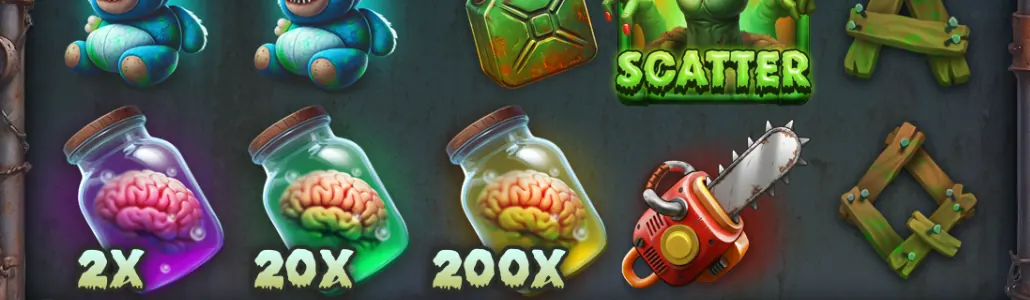
The jars are the second kind of Wild and the most recognisable thing on the board: three glass jars with a brain floating in each, lit purple, green and amber, with a multiplier printed across the front in the game's own lettering. The values are 2x, 20x and 200x, and they appear both on the board during play and on the panel the game shows before the session starts, which is unusually generous — most slots make a reader find the paytable.
The jars are tied to the respin round by that same panel: STICKY WILDS TRIGGER BRAIN LAB RESPINS. A sticky Wild holds its position while the rest of the board turns again, and the jars are what a held position tends to be carrying. The arrangement is easy to picture — the board keeps what it has and tries again for more — and it is the reason a round of this kind is where the three-figure multipliers show up.
What is not published is how the three values are distributed: nobody states how often a 200x jar lands rather than a 2x one, and nothing here estimates it. The jump from 2x to 20x to 200x is a tenfold step each time, which tells a reader something about the shape of the game without telling them anything about its frequency.
Expanded Wilds that roam
The third behaviour is the one the published list calls Walking Wilds and the opening screen calls an expanded Wild that roams: EXPANDED WILDS ROAM THE REELS. The two names describe the same thing from two angles. Expanded is about shape — the Wild grows to fill its column. Walking is about time — it is still there on the next spin, one reel further along.
A walking Wild is a different proposition from a stacked one even though both end up covering a column. A stack is a single event: it lands, it pays or it does not, and the board moves on. A walker is a sequence: it covers a column, the reels turn, it covers the next column, and anything that lands around it in the meantime is being read against a board that is already part Wild. On a sixteen-line board that compounding is what the studio's high volatility word is describing.
The panel showing this behaviour is the third of the three the game displays, and it shows two character Wilds standing in adjacent columns with the rest of the board blurred — the visual shorthand for movement. It is the only one of the three panels that implies a sequence rather than a single screen.
Scatter and the regular symbols
The Scatter is a green hand under the word SCATTER. It is the only symbol on the board whose position does not matter: the regular symbols pay on the 16 lines, left to right from the leftmost reel, and the Scatter is counted wherever it falls. That is why it is drawn so differently from everything else — a green plate against a board of coloured character frames and wooden planks.
The regular cast is a bearded lumberjack with an axe, a cheerleader with a bow, a chef in a red frame, a glowing teddy bear, a fuel can, a chainsaw, a medical case and four wooden letters. The four letter symbols sit at the bottom of the table, the objects in the middle, and the characters in their coloured frames at the top; a reader can rank them by eye before seeing a single payout figure, which is a sign of a well-drawn paytable rather than a fact about the maths.
A symbol value is not a ceiling
200x and 10,000x are the two largest numbers attached to this game, and they measure different things. 200x is the top value the game shows on a Wild stack: it is a multiplier carried by one symbol, applied inside a result. 10,000x is the limit on the whole result, published by Popiplay and printed by the game under its own logo.
The two get collapsed into one number often enough that it is worth stating the relation plainly: a stack carrying 200x is an ingredient, and 10,000x is the top of the pot. Neither figure is a prediction, and neither becomes more likely because the other one is large.
The symbols, asked one at a time
| What are Stacked Wilds? | A Wild that arrives several cells tall and can fill a whole column of the board, so one symbol enters several of the sixteen lines at once. |
|---|---|
| What is the top stack value shown? | 200x. The game's own opening screen prints it, and a recorded screen shows three columns carrying 5x, 2x and 200x side by side. |
| What makes a Wild sticky? | It stays in place while the reels around it turn again. That is what opens the Brain Lab respin round. |
| Which values are on the Brain Jars? | 2x, 20x and 200x, printed on the jars themselves in the game. |
| How can I spot the Scatter among the zombie symbols? | a green hand under the word SCATTER, on a green plate that matches none of the other symbols. |
| Is 200x the maximum win? | No. 200x is a value on one symbol; the ceiling on a whole result is 10,000x the bet. |
Related pages
How these three behaviours sit inside the published list of eight is taken apart on the features page.
The round a sticky Wild opens is described on the free rounds page, and every number with its source is on the game information page.